Posts

Scoring Beliefs and Conclusions: An Algorithmic Approach for an Online Forum

This online forum employs a relational database to catalog reasons supporting or opposing various conclusions. It allows users to submit a belief as evidence to back another belief (Refer to Figure #1). According to Equation #1, a conclusion receives a score derived from the scores of its underpinning assumptions. Similarly, assumption scores are calculated based on their corresponding assumptions, until we reach verifiable data. Basic Algorithm: Conclusion Score (CS) is a weighted sum of different types of scores, each calculated as the difference between supporting and opposing elements for the given conclusion. It is represented as: Conclusion Score (CS) = ∑ [(LS * RS_agree - LS * RS_disagree) * RIW] + ∑ [(LS * ES_agree - LS * ES_disagree) * EIW] + ∑ [(LS * IS_agree - LS * IS_disagree) * IIW] + ∑ [(LS * BS_agree - LS * BS_disagree) * BIW] + ∑ [(LS * IMS_agree - LS * IMS_disagree) * IMIW] + ∑ [(LS * MS_agree - LS * MS_disagree) * MIW] Where: CS: Conclusion Score LS is the Linkage Sco...
Enriching Mathematical Learning Through the Practical Application of Algorithms

Dear Esteemed Mathematics Educators, I am reaching out to you today with an exciting proposition - a unique opportunity to engage your students in the application of mathematical principles in an unconventional and meaningful way. It involves a novel algorithm designed to evaluate and promote ideas based on the strength of the reasoning and evidence provided. Here is the formula we're discussing: Conclusion Score (CS) = ∑ [(LS * RS_agree - LS * RS_disagree) * RIW] + ∑ [(LS * ES_agree - LS * ES_disagree) * EIW] + ∑ [(LS * IS_agree - LS * IS_disagree) * IIW] + ∑ [(LS * BS_agree - LS * BS_disagree) * BIW] + ∑ [(LS * IMS_agree - LS * IMS_disagree) * IMIW] + ∑ [(LS * MS_agree - LS * MS_disagree) * MIW] More detailed information about these variables can be found on our websites: https://github.com/myklob/ideastockexchange and https://www.groupintel.org/. In an era where discourse is increasingly digitized, this algorithm operates within a web-based forum. It allows users to submit reaso...

An open letter to Math teachers

Image
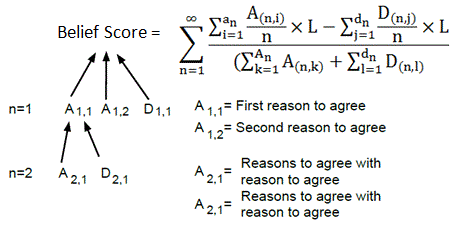
I am writing you to ask for your assistance in promoting "good idea promoting algorithms" such as the following: The above formula would work in an environment were you were able to submit reasons to agree or disagree with a belief, and then you could submit reasons to agree or disagree with those arguments. With this format it place you could count the reasons to agree and subtract the number of reasons to disagree, and then you could integrate the series of reasons to agree with reasons to agree. You should use this equation because: It is unique. I have never seen someone use an algorithm in an attempt to promote good ideas. Math can become more interesting when kids see the variety of ways it can be applied.  Kids are idealistic, and often want to improve the world. Challenging them to try to come up with a good idea promoting algorithm can use this energy, to learn math. This simple that counts the reasons to agree with a conclusion, could change the wold, similar to...

Optimal Algorithm for Online Forums Utilizing Relational Databases for Debate

Image
In an online forum that utilizes a relational database to track arguments either supporting or countering conclusions, and allows users to submit their beliefs as reasons to support other beliefs, the deployment of the following algorithm can prove highly advantageous: Or with math: The equation for the idea score can be represented as: Basic Algorithm: Conclusion Score (CS) is a weighted sum of different types of scores, each calculated as the difference between supporting and opposing elements for the given conclusion. It is represented as: Conclusion Score (CS) = ∑ [(LS * RS_agree - LS * RS_disagree) * RIW] + ∑ [(LS * ES_agree - LS * ES_disagree) * EIW] + ∑ [(LS * IS_agree - LS * IS_disagree) * IIW] + ∑ [(LS * BS_agree - LS * BS_disagree) * BIW] + ∑ [(LS * IMS_agree - LS * IMS_disagree) * IMIW] + ∑ [(LS * MS_agree - LS * MS_disagree) * MIW] Where: CS: Conclusion Score LS is the Linkage Score, representing the strength of the connection between an argument and the conclusion it suppo...

Math Question

Image
I have a math equation I want to express correctly, but I have been out of college for 10 years and I’m a little rusty. This is my attempt, but I’m not sure I have the series written correctly: n = number of steps an argument is removed from an idea, where a reason to agree is one step removed, but a reason to agree with a reason to agree is two steps.   A 1 = Number of reasons to agree (Count as 1 point each, towards the idea) D 1  = Number of reasons to disagree (Count as 1 point each, towards the idea) A 2 = Number of reasons to agree with reasons to agree or disagree with reasons to disagree (Count as 1/2 point each, towards the idea) D 2  = Number of reasons to disagree with reasons to agree or agree with reason to disagree (Count as 1/2 point each, towards the idea) and so on I’m not sure I have enough summation symbols.  If I define A sub 1 as “Number of” can I leave out the extra summation symbols shown in this equation:

Other Factors: Additional Evidence such as Movies, Songs, Expert Opinions

Similar to books, various forms of media like movies (particularly documentaries), songs, or expert opinions can offer support or opposition to different perspectives. For instance, the website Rotten Tomatoes offers scores for movies which can be an indicator of the general consensus about the argument or message a film is putting forward. This data could be integrated into the evaluation of a belief or argument, along with any formal logical arguments presented within the media content. The Link Score (L): When beliefs are submitted as reasons to support other beliefs, there's a risk of irrelevant arguments being included. For example, someone might claim that the belief "the grass is green" is a reason to believe "the New York Giants will win the Super Bowl." Although the belief that "the grass is green" might have a high agreement score, the relevance or "Link Score" will be close to zero due to the lack of a logical connection. As this p...

Other Factors: Stuff, like movies, songs, experts, etc that agaree or disagree

Similar to how I say books can support or oppose different conclusions, movies (often documentaries) can support or oppose different conclusions. Rotten tomatoes gives scores to movies. All of this data could be imported, as well as the formal logical arguments that a movie actually attempts to support or oppose a belief. L = Link score. When we submit beliefs as reasons to support other beliefs, and give higher scores to conclusions that have more reasons to agree with them, people will try to submit beliefs that don’t really support the conclusion. For instance someone might post the belief that the grass is green as a reason to believe the NY Giants will win the super bowl. The beliefs that the grass is green will receive a high score, but the “Link Score” as will be close to zero. * As we work this out we may have to apply multiplication factors to not give too much or too little weight to a factor. ** Who has a “.edu” e-mail address from the philosophy department of an accredited ...

Other Factors: Up/Down Votes

Image
I think if we tracked the number of up votes and compared it to the number of down votes it might tell us a little about the quality of an argument, or at least its perceived quality. I think the more information the better. This is the best equation I can come up with for adding points to a belief based on the number of up or down votes. I would love your feedback. Below is an explanation of each term. Up/Down Votes UV /DV  = Up or Down Vote #U = Number of Users We will have overall up or down votes. We will also have votes on specific attributes like: logic, clarity, originality, verifiability, accuracy, etc.

Other Factors: Books that agree or Disagree

Image
I believe that tracking the number of books suggested as reasons to agree or disagree with a conclusion could help develop algorithms that promote beliefs that have been thoroughly examined and supported. Here's the best equation I've come up with for adding points to a belief based on the number and quality of books suggested as reasons to support or disagree with a conclusion: Points = Σ(BS * BLS) I'd appreciate your feedback on this approach and its potential effectiveness in promoting well-examined ideas. Below is an explanation of each term: B = Books that have been said to support or oppose the given conclusion BS = Book Score, which can take into account the number of books sold, scores given by book reviewers, etc. BLS = Book Link Score, which evaluates how well a book supports the proposed belief. Each argument that a book supports a belief becomes its own argument, and the book's "linkage score" is assigned points based on the equation provided above...

Other Factors: Incorporating Input from Logic Professors

Image
I once took a course in logic taught by a professor of philosophy, a discipline in which formal logic often plays a crucial role. My proposal involves quantifying the input of logic professors who "authenticate" the logic of an argument, juxtaposed against those who "contend" with the logic of the same argument. Such data could potentially bolster the credibility of ideas that have been meticulously scrutinized and validated. Consider this modified equation, using a ratio to add or subtract points from a belief based on the input of logic professors: Ratio = Number of times a certified logic instructor has authenticated the logic of a given argument (LPV) / Number of times a certified logic instructor has contested the logic of a given argument (LPC). Using this ratio, if a logic professor opposes a reason that underpins your conclusion, the overall score would decrease proportionately. This is because the action of contesting is twice removed from directly affirmin...