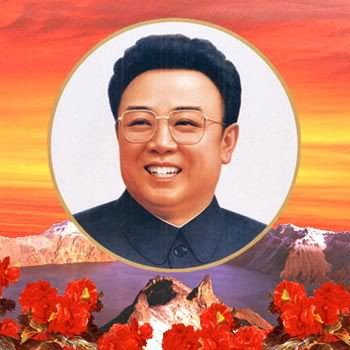
Obama says, “Yes we can”… Yes we can what?

Yes We Can, Bob the Builder?

Images are from : http://markcronan.livejournal.com/


http://farm3.static.flickr.com/2410/2281055812_4ef0b1e14e.jpg


From HotAir:

Beware the cult of personality in all its forms.

From Wikipedia:

A cult of personality or personality cult arises when a country's leader uses mass media to create a heroic public image through unquestioning flattery and praise. Cults of personality are often found in dictatorships but can be found in some democracies as well.

A cult of personality is similar to general hero worship except that it is created specifically for political leaders. However, the term may be applied by analogy to refer to adulation of non-political leaders.

Background

Throughout history, monarchs were almost always held in enormous reverence. Through the principle of the divine right of kings, rulers were said to hold office by the will of God. Imperial China (see Mandate of Heaven), ancient Egypt, Japan, the Inca, the Aztecs, and the Roman Empire (see imperial cult) are especially noted for redefining monarchs as god-kings.

The resurgence of ancient Greek democratic ideas in Europe and North America in the 18th and 19th centuries made it increasingly difficult for monarchs to preserve this aura. However, the subsequent development of photography, sound recording, film and mass production, as well as public education and techniques used in commercial advertising, enabled political leaders to project a positive image like never before. It was with these circumstances in the 20th century that the best-known personality cults arose.

Purpose

Generally, personality cults are most common in regimes with totalitarian systems of government, that seek to radically alter or transform society according to revolutionary new ideas. Often, a single leader becomes associated with this revolutionary transformation, and he becomes treated as a benevolent "guide" for the nation, without whom the transformation to a better future cannot occur. This has been generally the justification for personality cults that arose in totalitarian societies of the 20th century, such as that of Adolf Hitler and Joseph Stalin.

Not all dictatorships foster personality cults, however, and some leaders may actively seek to minimize their own public adulation. For example in Cuba public images of Fidel Castro are rare, and a personality cult around Castro is not encouraged officially, although images, posters, and billboards of Che Guevara abound. Even in the totalitarian regime of Pol Pot in Cambodia the image of Pol Pot himself was rarely seen, though in the latter's case this was merely to perpetuate the image of a faceless, invisible, omnipresent state leadership.[citation needed]

Examples from totalitarian regimes

The criticism of personality cults often focuses on the regimes of Mussolini, Hitler, Stalin, Josip Broz Tito, Mao, Saddam Hussein, Kim Il-sung and his son Kim Jong-il. During the peak of their reigns, these leaders were presented as god-like and infallible. Their portraits were hung in homes and public buildings, and artists and poets were instructed legally to produce only works that glorified the leader and their political movements. Other undemocratic leaders with such cults include leaders such as Eva Peron of Argentina and her husband Juan. The term cult of personality comes from Karl Marx's critique of the "cult of the individual" - expressed in a letter to German political worker, Wilhelm Bloss. In that, Marx states thus:

From my antipathy to any cult of the individual, I never made public during the existence of the [1st] International the numerous addresses from various countries which recognized my merits and which annoyed me… Engels and I first joined the secret society of Communists on the condition that everything making for superstitious worship of authority would be deleted from its statute.

Nikita Khrushchev recalled Marx's criticism in his 1956 "Secret Speech" denouncing Stalin to the 20th Party Congress:

Comrades, the cult of the individual acquired such monstrous size chiefly because Stalin himself, using all conceivable methods, supported the glorification of his own person. . . . One of the most characteristic examples of Stalin's self-glorification and of his lack of even elementary modesty is the edition of his Short Biography, which was published in 1948.[1].

This book is an expression of the most dissolute flattery, an example of making a man into a godhead, of transforming him into an infallible sage, "the greatest leader," "sublime strategist of all times and nations." Finally no other words could be found with which to lift Stalin up to the heavens.

We need not give here examples of the loathsome adulation filling this book. All we need to add is that they all were approved and edited by Stalin personally and some of them were added in his own handwriting to the draft text of the book.

Journalist Bradley Martin documented the personality cults of North Korea's father-son leadership, "Eternal (formerly Great) Leader" Kim Il-sung and "Great (formerly Dear) Leader" Kim Jong-il.[2] While visiting North Korea in 1979 he noted that nearly all music, art, and sculpture that he observed glorified "Great Leader" Kim Il-sung, whose personality cult was then being extended to his son, "Dear Leader" Kim Jong-il.[2] Kim Il-sung rejected the notion that he had created a cult around himself and accused those who suggested so of "factionalism."[2] A US religious freedom investigation confirmed Martin's observation that North Korean schoolchildren learn to thank Kim Il-sung for all blessings as part of the cult.[3]

Former President Saparmurat Niyazov of Turkmenistan is another oft-cited cultivator of a cult of personality.[4][5][6] Niyazov simultaneously cut funding to and partially disassembled the education system in the name of 'reform,' while injecting ideological indoctrination into it by requiring all schools to take his own book, the Ruhnama, as its primary text.[7][8] During Niyazov's rule there was no freedom of the press nor was there freedom of speech. This further meant that opposition to Niyazov was strictly forbidden and "major opposition figures have been imprisoned, institutionalized, deported, or have fled the country, and their family members are routinely harassed by the authorities."[9] Additionally, a silhouette of Niyazov was placed on the screen of all television broadcasts[10] and statues and pictures of him were 'erected everywhere.'[11]. For these, and other reasons, the US Government has gone on to claim that by the time he died, "Niyazov's personality cult…had reached the dimensions of a state-imposed religion."[12].

University of Chicago professor Lisa Wedeen's book, "Ambiguities of Domination" documents the cult of personality which surrounded late Syrian President Hafez al-Assad. Numerous examples of his glorification are made throughout the book, such as displays of love and adoration for the "leader" put on at the opening ceremonies of the 1987 Mediterranean Games in Lattakia Syria.

References


  1. ^ The Cult of the Individual. Retrieved on 2007-05-24.
  2. ^ a b c Bradley K. Martin. Under the Loving Care of the Fatherly Leader: North Korea and the Kim Dynasty. ISBN 0-312-32322-0
  3. ^ Thank You Father Kim-Il-Sung. Retrieved on 2007-12-09.
  4. ^ Government of the United States of America. March 2002. Report on Turkmenistan. Available on-line at http://www.ciaonet.org/
  5. ^ International Crisis Group. July 2003. Central Asia: Islam and the State. ICG Asia Report No. 59. Available on-line at http://www.crisisgroup.org/
  6. ^ Shikhmuradov, Boris. May 2002. Security and Conflict in Central Asia and the Caspian Region. International Security Program, Belfer Center for Science and International Affairs, Harvard University. Available on-line at http://www.ciaonet.org/
  7. ^ International Crisis Group. July 2003. Central Asia: Islam and the State. ICG Asia Report No. 59. Available on-line at http://www.crisisgroup.org/
  8. ^ Soucek, Svat. 2000. A History of Inner Asia. Cambridge: Cambridge University Press.
  9. ^ Government of the United States of America. March 2002. Report on Turkmenistan. Available on-line at http://www.ciaonet.org/
  10. ^ Eurasianet. 2007. The Personality Cult Lives On, Residents Take It In Stride. Available on-line at http://www.eurasianet.org/
  11. ^ BBC. December 2006. Obituary: Saparmurat Niyazov.Available on-line at http://news.bbc.co.uk/2/hi/asia-pacific/6199021.stm
  12. ^ United States Commission on International Freedom. 2007. Turkmenistan: Ending the Personality Cult. Available on-line at http://www.uscirf.gov/mediaroom/press/2007/january/20070103Turkmenistan.html

See also

Jihadism, like the cult of personality that follows Barkak Obama, is a youth movement, that promises change from the existing world order. Change, in and of itself, is not good. Cobra Commander can promise change. Karl Marx wanted Change. There was a stalinist youth movement. All the "cool" kids liked Stalin. Hitler had a youth movement. Sexy actresses liked Hitler. People will distort what I am saying. Obama is nothing like Stalin. Obama is nothing like Hitler. Obama may be good for our country. Obama might take us down the right path. But being popular with young, attractive, popular people does not mean that his policies are good. What are my greatest fears with Obama? We have a good country, with a balance of powers. We have the Judicial, legislative, and executive branches. But the founding fathers were concerned with about passions of the moment.

Could we in America have an elected official have a "bad" cult of personality? I think we are drifting that way. President Washington didn't want anyone's face on our money, and we didn't put anyones face on our money, until the 1900s. Wouldn't that tick you off, if you were George Washington? He specifically asked us not to put anyones face on the money, and we go and put HIS face on our money! Then in 1913, we think we know better than the founding fathers how to elect people to congress, and we decide that both houses of congress will be "baby kissers".

We already have a cult of personality with the presidents on our money, two houses of baby kissers, MTV & "Rock-the-vote", celebrities who never graduated from high-school (let alone college) thinking that they should tell us how to vote…

I can see the cult-of personality when you can't criticize Obama without being called a racist. It's the dumbing down of our culture. It's symbolism over substance. "We have the opportunity to truly transcend color this year by treating Barack Obama exactly the same we treated Michael Dukakis."

Obama said he is a uniter, but he brought his daughters for 20 years to a church that damns the United States of KKK. He had the most liberal voting record in the senate. He was more liberal than Dennis Kucinich. It is scary to have a guy who is more liberal than Dennis Kucinich as president, whom you can't criticize without being called a racist. But you can critisize him with some people. Not everyone calls you a racist, but they do not treat him equally. For instance, Obama said he had been to all 57 states. If Bush had said that, it would have been on every news channel. But it is not "cool" to make fun of Obama. Until now. YES WE SHALL!

Obama says, “Yes we can”… Yes we can what?


Yes We Can, Bob the Builder?

http://farm3.static.flickr.com/2410/2281055812_4ef0b1e14e.jpg


Images are from : http://markcronan.livejournal.com/


From HotAir:


Beware the cult of personality in all its forms.

From Wikipedia:


A cult of personality or personality cult arises when a country's leader uses mass media to create a heroic public image through unquestioning flattery and praise. Cults of personality are often found in dictatorships but can be found in some democracies as well.

A cult of personality is similar to general hero worship except that it is created specifically for political leaders. However, the term may be applied by analogy to refer to adulation of non-political leaders.


Background


Throughout history, monarchs were almost always held in enormous reverence. Through the principle of the divine right of kings, rulers were said to hold office by the will of God. Imperial China (see Mandate of Heaven), ancient Egypt, Japan, the Inca, the Aztecs, and the Roman Empire (see imperial cult) are especially noted for redefining monarchs as god-kings.

The resurgence of ancient Greek democratic ideas in Europe and North America in the 18th and 19th centuries made it increasingly difficult for monarchs to preserve this aura. However, the subsequent development of photography, sound recording, film and mass production, as well as public education and techniques used in commercial advertising, enabled political leaders to project a positive image like never before. It was with these circumstances in the 20th century that the best-known personality cults arose.


Purpose


Generally, personality cults are most common in regimes with totalitarian systems of government, that seek to radically alter or transform society according to revolutionary new ideas. Often, a single leader becomes associated with this revolutionary transformation, and he becomes treated as a benevolent "guide" for the nation, without whom the transformation to a better future cannot occur. This has been generally the justification for personality cults that arose in totalitarian societies of the 20th century, such as that of Adolf Hitler and Joseph Stalin.

Not all dictatorships foster personality cults, however, and some leaders may actively seek to minimize their own public adulation. For example in Cuba public images of Fidel Castro are rare, and a personality cult around Castro is not encouraged officially, although images, posters, and billboards of Che Guevara abound. Even in the totalitarian regime of Pol Pot in Cambodia the image of Pol Pot himself was rarely seen, though in the latter's case this was merely to perpetuate the image of a faceless, invisible, omnipresent state leadership.[citation needed]


Examples from totalitarian regimes


The criticism of personality cults often focuses on the regimes of Mussolini, Hitler, Stalin, Josip Broz Tito, Mao, Saddam Hussein, Kim Il-sung and his son Kim Jong-il. During the peak of their reigns, these leaders were presented as god-like and infallible. Their portraits were hung in homes and public buildings, and artists and poets were instructed legally to produce only works that glorified the leader and their political movements. Other undemocratic leaders with such cults include leaders such as Eva Peron of Argentina and her husband Juan. The term cult of personality comes from Karl Marx's critique of the "cult of the individual" - expressed in a letter to German political worker, Wilhelm Bloss. In that, Marx states thus:


From my antipathy to any cult of the individual, I never made public during the existence of the [1st] International the numerous addresses from various countries which recognized my merits and which annoyed me… Engels and I first joined the secret society of Communists on the condition that everything making for superstitious worship of authority would be deleted from its statute.

Nikita Khrushchev recalled Marx's criticism in his 1956 "Secret Speech" denouncing Stalin to the 20th Party Congress:


Comrades, the cult of the individual acquired such monstrous size chiefly because Stalin himself, using all conceivable methods, supported the glorification of his own person. . . . One of the most characteristic examples of Stalin's self-glorification and of his lack of even elementary modesty is the edition of his Short Biography, which was published in 1948.[1].


This book is an expression of the most dissolute flattery, an example of making a man into a godhead, of transforming him into an infallible sage, "the greatest leader," "sublime strategist of all times and nations." Finally no other words could be found with which to lift Stalin up to the heavens.


We need not give here examples of the loathsome adulation filling this book. All we need to add is that they all were approved and edited by Stalin personally and some of them were added in his own handwriting to the draft text of the book.

Journalist Bradley Martin documented the personality cults of North Korea's father-son leadership, "Eternal (formerly Great) Leader" Kim Il-sung and "Great (formerly Dear) Leader" Kim Jong-il.[2] While visiting North Korea in 1979 he noted that nearly all music, art, and sculpture that he observed glorified "Great Leader" Kim Il-sung, whose personality cult was then being extended to his son, "Dear Leader" Kim Jong-il.[2] Kim Il-sung rejected the notion that he had created a cult around himself and accused those who suggested so of "factionalism."[2] A US religious freedom investigation confirmed Martin's observation that North Korean schoolchildren learn to thank Kim Il-sung for all blessings as part of the cult.[3]

Former President Saparmurat Niyazov of Turkmenistan is another oft-cited cultivator of a cult of personality.[4][5][6] Niyazov simultaneously cut funding to and partially disassembled the education system in the name of 'reform,' while injecting ideological indoctrination into it by requiring all schools to take his own book, the Ruhnama, as its primary text.[7][8] During Niyazov's rule there was no freedom of the press nor was there freedom of speech. This further meant that opposition to Niyazov was strictly forbidden and "major opposition figures have been imprisoned, institutionalized, deported, or have fled the country, and their family members are routinely harassed by the authorities."[9] Additionally, a silhouette of Niyazov was placed on the screen of all television broadcasts[10] and statues and pictures of him were 'erected everywhere.'[11]. For these, and other reasons, the US Government has gone on to claim that by the time he died, "Niyazov's personality cult…had reached the dimensions of a state-imposed religion."[12].

University of Chicago professor Lisa Wedeen's book, "Ambiguities of Domination" documents the cult of personality which surrounded late Syrian President Hafez al-Assad. Numerous examples of his glorification are made throughout the book, such as displays of love and adoration for the "leader" put on at the opening ceremonies of the 1987 Mediterranean Games in Lattakia Syria.


References


  1. ^ The Cult of the Individual. Retrieved on 2007-05-24.

  2. ^ a b c Bradley K. Martin. Under the Loving Care of the Fatherly Leader: North Korea and the Kim Dynasty. ISBN 0-312-32322-0

  3. ^ Thank You Father Kim-Il-Sung. Retrieved on 2007-12-09.

  4. ^ Government of the United States of America. March 2002. Report on Turkmenistan. Available on-line at http://www.ciaonet.org/

  5. ^ International Crisis Group. July 2003. Central Asia: Islam and the State. ICG Asia Report No. 59. Available on-line at http://www.crisisgroup.org/

  6. ^ Shikhmuradov, Boris. May 2002. Security and Conflict in Central Asia and the Caspian Region. International Security Program, Belfer Center for Science and International Affairs, Harvard University. Available on-line at http://www.ciaonet.org/

  7. ^ International Crisis Group. July 2003. Central Asia: Islam and the State. ICG Asia Report No. 59. Available on-line at http://www.crisisgroup.org/

  8. ^ Soucek, Svat. 2000. A History of Inner Asia. Cambridge: Cambridge University Press.

  9. ^ Government of the United States of America. March 2002. Report on Turkmenistan. Available on-line at http://www.ciaonet.org/

  10. ^ Eurasianet. 2007. The Personality Cult Lives On, Residents Take It In Stride. Available on-line at http://www.eurasianet.org/

  11. ^ BBC. December 2006. Obituary: Saparmurat Niyazov.Available on-line at http://news.bbc.co.uk/2/hi/asia-pacific/6199021.stm

  12. ^ United States Commission on International Freedom. 2007. Turkmenistan: Ending the Personality Cult. Available on-line at http://www.uscirf.gov/mediaroom/press/2007/january/20070103Turkmenistan.html


See also


Jihadism, like the cult of personality that follows Barkak Obama, is a youth movement, that promises change from the existing world order. Change, in and of itself, is not good. Cobra Commander can promise change. Karl Marx wanted Change. There was a stalinist youth movement. All the "cool" kids liked Stalin. Hitler had a youth movement. Sexy actresses liked Hitler. People will distort what I am saying. Obama is nothing like Stalin. Obama is nothing like Hitler. Obama may be good for our country. Obama might take us down the right path. But being popular with young, attractive, popular people does not mean that his policies are good. What are my greatest fears with Obama? We have a good country, with a balance of powers. We have the Judicial, legislative, and executive branches. But the founding fathers were concerned with about passions of the moment.

Could we in America have an elected official have a "bad" cult of personality? I think we are drifting that way. President Washington didn't want anyone's face on our money, and we didn't put anyones face on our money, until the 1900s. Wouldn't that tick you off, if you were George Washington? He specifically asked us not to put anyones face on the money, and we go and put HIS face on our money! Then in 1913, we think we know better than the founding fathers how to elect people to congress, and we decide that both houses of congress will be "baby kissers".

We already have a cult of personality with the presidents on our money, two houses of baby kissers, MTV & "Rock-the-vote", celebrities who never graduated from high-school (let alone college) thinking that they should tell us how to vote…

I can see the cult-of personality when you can't criticize Obama without being called a racist. It's the dumbing down of our culture. It's symbolism over substance. "We have the opportunity to truly transcend color this year by treating Barack Obama exactly the same we treated Michael Dukakis."

Obama said he is a uniter, but he brought his daughters for 20 years to a church that damns the United States of KKK. He had the most liberal voting record in the senate. He was more liberal than Dennis Kucinich. It is scary to have a guy who is more liberal than Dennis Kucinich as president, whom you can't criticize without being called a racist. But you can critisize him with some people. Not everyone calls you a racist, but they do not treat him equally. For instance, Obama said he had been to all 57 states. If Bush had said that, it would have been on every news channel. But it is not "cool" to make fun of Obama. Until now. YES WE SHALL!
Keeping Americans Safe

Issues: Keeping Americans Safe


We must ensure that our intelligence and law enforcement efforts are able to address threats before they reach our shores.

Reasons to agree:

  1. Addressing threats means learning about them, studying them, and working with other governments in stopping them.

Reasons to disagree:
  1. Blow-back. If we don't "address threats" in a smart way, it might create resentment.

Webpages that agree
  1. http://www.fbi.gov/
  2. https://www.cia.gov/
  3. http://www.state.gov/

4% of GDP on the military?

Issues / Keeping Americans Safe

Romney has said that, we should spend at lest 4 percent of GDB on defense.

Reasons to agree

  1. This kind of investment will make up for critical gaps in the modernization of our equipment, personnel and health care efforts.
  2. We have typically spent about 4% of GDP on defense.
  3. 4% is a good amount, given our challenges.
  4. Most countries spend about 4% of their GDP. Sometimes people try to make a big deal about how we spend more than other countries, but that is just because our economy is so much bigger than most other countries. Indonesia spends a higher percent of GDP, so does China. Saudi Arabia spend about twice as much as we do. We have a lot of land. Our people are spread out over a large distance. Everyone wants to take out the big dog. We are the protectors of the free world from despotic, tyrannical countries that want to rule the world, and are willing to kill others to be in charge... We would like it if other democracies carried their portion of the responsibilities, but because they won't, we have to protect them.

Interest of those who agree
  1. Protecting democracy, freedom of the press, rule of law, and those ideals that would fall to fascism, if America was not protecting this planet.

Interest of those who disagree
  1. Trying to get all countries to spend less on defense, and more on education, farming, and stuff.

Books that agree
#

Books that agree
#

Web pages that agree
#

Web pages that disagree
#

People should have to pass drug test to get government assistance.

Governor Mitt Romney and Drugs

2003

2005

  • 12-20-2005; HEALEY EXPANDS SUBSTANCE ABUSE TREATMENT FOR WOMEN
  • 07-28-2005; HEALEY ENDORSES MANDATORY OVERDOSE REPORTING BILL

2006

  • 06-30-2006; ROMNEY VETOES NEEDLES BILL; Says legislation will worsen heroin crisis by loosening drug paraphernalia laws
  • 12-21-2005; HEALEY KICKS OFF STUDENT DRUG TESTING PROGRAM IN NEW BEDFORD
Also see Gangs

People should have to pass drug test to get government assistance.

Reasons to agree

  1. I have to pass a drug test to work. I hate work. I wish I could get money for doing nothing. If I have to pass a drug test, to have the honor of working, people should have to pass a drug test, if they want free money.
  2. Like a lot of folks in this state I have a job. I work, they pay me. I pay my taxes and the government distributes my taxes as it sees fit. In order to get that paycheck, I am required to pass a random urine test, with which I have no problem. What I do have a problem with is the distribution of my taxes to people who don't have to pass a urine test. Shouldn't one have to pass a urine test to get a welfare check because I have to pass one to earn it for them? Please understand, I have no problem with helping people get back on their feet. I do on the other hand have a problem with helping someone sitting on their ass. Could you imagine how much money the state would save if people had to pass a urine test to get a public assistance check????? Please pass this along if you agree or simply Delete if you don't. Hope you all will pass it along, though. Something has to change in this country and soon!!!!! "

Gangs

I would be interested to hear from anyone who has been a victim of gang activity. I think gangs are a big threat to our country. From Norco-terrorist, to the good old fashioned street gangs. I think Mitt Romney has good executive experience working with the police in Massachusetts to stand up to Crime.

Quotes from Governor Mitt Romney about gangs:

  • "Gang violence destroys the fabric of our communities and offers nothing but a dead end street to young people drawn in by false hope," said Romney. "This program will encourage communities to develop and pursue promising new strategies that stop the mayhem and bloodshed that gangs inflict."
  • "Our criminal justice and public safety professionals now have a real tool to protect those who join with us to take a stand against crime and violence in our communities," Romney said during the ceremony at St. Peter's School, which specializes in youth programs that have shown great success in keeping students out of gangs and connecting them to their community. "Witnesses who have the courage to come forward and testify should not have to live in fear for cooperating with prosecutors to keep their communities safe."
    • Governor Mitt Romney
  • "Nothing troubles me more than watching a child's future shatter in a blast of violence. Our call for action will give law enforcement officials additional resources to protect the lives of our children and their families."

Press Releases from Governor Mitt Romney about gangs:

2004

  • 08-26-2004, LT. GOV HEALEY SIGNS BILL CRACKING DOWN ON SOMERVILLE GANGS
  • 10-01-2004, ROMNEY ANNOUNCES $1.5 MILLION TO COMBAT GANG ACTIVITY

2005

  • 12-15-2005, HEALEY PUSHES TO GIVE PROSECUTORS TOOLS TO PROTECT CRUCIAL WITNESSES IN GANG CRIMES
  • 12-22-2005, ROMNEY APPROVES $11 MILLION PLAN TO TARGET GANG VIOLENCE

2006

  • 03-06-2006, HEALEY PUSHES FOR PASSAGE OF ANTI-GANG VIOLENCE BILL
  • 03-30-2006, ROMNEY SIGNS BILL TO CRACK DOWN ON GANG VIOLENCE
  • 05-17-2006, HEALEY AND MENINO ANNOUNCE $3 MILLION GANG-FIGHTING GRANT FOR BOSTON
  • 05-18-2006, HEALEY AWARDS GANG-FIGHTING GRANTS TO 15 COMMUNITES

Raising the Bar on Education

Issues / Raising the Bar on Education

Governor Mitt Romney said everyone benefits when parents and kids can choose their schools.

I would like to hear your reasons to agree or disagree; until then, here are my Reasons to agree with Romney:

  1. It is best to trust individuals to make decisions for their own lives.
  2. Choice is good.
  3. School choice is good.
  4. Parental Rights and Practicality: While school choice might not be feasible for every family, it honors parents' rights to choose the best educational path for their children, whether Catholic, public, or any other type of school.
  5. Informed Decisions: With the freedom to choose, media outlets could offer evaluations and comparisons of schools, fostering a culture where education is a priority, akin to everyday consumer choices. This increased scrutiny and interest could lead to better-informed decisions about children’s education.
  6. Choice and Access: Just as bookstores and libraries coexist, providing choice doesn't necessarily harm public schools. The focus should be on ensuring access to education through public, private, or homeschooling options.
  7. Use of Tax Money: Questioning the use of tax money for private or homeschooling overlooks the fundamental right of parents to decide the best educational setting for their children.
  8. Educational Outcomes: Evidence suggests Catholic and other non-public schools often outperform public schools, hinting at the benefits of competitive educational environments.
  9. Competition Drives Quality: Introducing competition among schools, including charter and homeschooling options, raises the quality of public education and aligns with the broader American value of competition improving services.
  10. Economic Incentives: While many teachers are motivated by altruism, economic incentives in a competitive educational system could drive improvements across all schools.
  11. Government Efficiency: Drawing a parallel with government services like the DMV, the argument posits that government-controlled entities often lack the motivation to excel and improve, a situation that school choice aims to remedy.
  12. Critique of Opposition Arguments:
    1. Affordability and Equity: Critics argue school choice might not be universally accessible, but this perspective overlooks the direct and indirect benefits to the majority, as well as the potential for a more dynamic educational environment.
    2. Historical Misuse of Private Schools: While some argue private schools contributed to segregation in the past, today's school choice mechanisms, like vouchers, aim to democratize access to quality education, potentially reducing educational inequality.
    3. Community Impact: Though some believe school choice might erode community cohesion, supporters argue that educational quality and parental empowerment should take precedence, with the belief that better education contributes to stronger communities in the long run.

What are the best objective criteria for measuring the strength of this belief?

1. Academic Outcomes

  • Improvement in Student Performance: Measure the academic progress of students who switch to schools of choice compared to those who remain in failing schools. Metrics can include standardized test scores, graduation rates, and college admission rates.

2. Equity and Accessibility

  • Demographic Representation: Analyze whether school choice options are equally accessible to students of all socioeconomic backgrounds, races, and abilities. This includes assessing the distribution of resources and opportunities.
  • Impact on Segregation: Study the effect of school choice on racial and socioeconomic segregation within and across schools.

3. Systemic Effects

  • Impact on Public Schools: Evaluate how the introduction of school choice affects the funding, resources, and student body composition of remaining public schools.
  • Overall System Performance: Compare the performance and health of the educational system as a whole in regions with robust school choice options versus those without.

4. Parental and Student Satisfaction

  • Satisfaction Surveys: Collect data on satisfaction levels from parents and students involved in school choice programs to gauge perceived benefits or drawbacks.
  • Enrollment Trends: Track enrollment patterns over time as an indirect measure of satisfaction and demand for school choice options.

5. Economic Efficiency

  • Cost-Benefit Analysis: Assess the financial efficiency of school choice programs by comparing the costs of these programs to their academic and social outcomes.
  • Resource Allocation: Examine how resources are allocated among public schools and schools of choice, including per-pupil spending and investment in infrastructure.

6. Long-term Outcomes

  • Post-Secondary Success: Monitor the long-term success of students participating in school choice, including higher education attainment and career outcomes.
  • Social Mobility: Investigate the impact of school choice on students' social mobility, especially for those from historically underserved communities.

Reasons to agree

  1. When parents and kids are free to choose their school everyone benefits. +17
  2. School choice is good. +13
  3. Choice is good. +8
  4. It is best to trust individuals to make decisions for their own lives. +3 
  5. Its not fair that poor kids have no option but to go to failing schools.
  6. Its not good for our future to have segments of our population stuck in failing schools.
  7. Kids should have access to the resources and opportunities they need to succeed.


Score: +7 (reasons to agree), + 41/2 [20] (reasons to agree with reasons to agree) = 27


Movies that agree:

  1. Waiting for "Superman" (2010): This documentary critiques the American public education system by following several students as they attempt to be accepted into a charter school. 

Movies that disagree:

  1. The Public (2018): Though not directly about school choice, this movie highlights the broader societal issues contributing to the failure of public institutions, suggesting the need for systemic reform rather than alternatives like school choice. 

Interest of those who agree

  1. Parents and Students seeking better educational opportunities.
  2. Advocates for Market-Based Solutions who believe competition can improve school quality.
  3. Charter and Private School Administrators who stand to gain enrollment and funding.


Interest of those who disagree

  1. Public School Advocates and Educators concerned about the diversion of funds from public schools.
  2. Critics of Segregation and Inequality who argue that school choice can exacerbate educational disparities.
  3. Supporters of Community-Based Solutions who favor improving schools through increased funding and community involvement rather than offering alternatives that might only benefit a few. 

Books that agree

  1. The School Choice Roadmap: 7 Steps to Finding the Right School for Your Child" by Andrew Campanella: Offers a practical guide for parents navigating school choice.
  2. "Education Myths: What Special Interest Groups Want You to Believe About Our Schools--And Why It Isn't So" by Jay P. Greene: Debunks common misconceptions about public education and argues for the benefits of school choice.

Books that agree

  1.  "Reign of Error: The Hoax of the Privatization Movement and the Danger to America's Public Schools" by Diane Ravitch: Critiques the movement toward privatizing public education, including arguments against school choice.
  2. "Slaying Goliath: The Passionate Resistance to Privatization and the Fight to Save America's Public Schools" by Diane Ravitch: Focuses on the efforts to resist educational privatization and supports public education reform.

Web pages that agree

  1.   Organizations like The Heritage Foundation or The Friedman Foundation for Educational Choice often publish articles and policy papers in favor of school choice, presenting it as a solution to failing schools.

Web pages that disagree

  1. The National Education Association (NEA) and American Federation of Teachers (AFT) frequently outline the downsides of school choice on their platforms, focusing on its impact on public education funding and equity. 

We should build and repair transportation infrastructure.

Reasons to agree

  1. We should invest in infrastructure projects critical to the national economy and its flow of goods and people, instead of funding home-district pork.

Featured Post

David's Sling by Marc Stiegler is a Great Book

Home › Topics › Book Analysis › David's Sling David's Sling by Marc Stiegler is a Great Book Current Status: Cult Cl...

Popular Posts